

Dhamma Body : ค้นหาหนังสือธรรมะ หน้า 3 / 20
หน้าหนังสือทั้งหมด
41
Understanding Dhammakāya: A Scholarly Interpretation
Points to Consider
It may be observed that the difference in previous scholarly interpretations of the term dhammakāya in this passage mainly pertains to the inter-relatedness of two distinctive meani
This text delves into scholarly interpretations of the term 'dhammakāya', emphasizing the need for a nuanced understanding of 'dhamma' as both a realized reality and a verbal expression. It identifies
60
Understanding Dhammakāya: The Essence of Transcendental Dhamma
Arhatship (arahattamagga).86 Therefore, the particular path is not a mere ‘collective title’ of the path-constituents but the ‘essential totality’ by which a ‘body’ is defined.
The dependence of funct
This text discusses the concept of Arhatship and the definition of Dhammakāya in the context of Buddhist philosophy. It argues that the path should be seen as an essential totality, forming a 'body,'
75
Dhamma Talk with Luang Por at the Peace Revolution Conference
Meeting #13
04 March 2010 – International Buddhist Association Building
Luang Por has agreed to meet with the members of the Peace Revolution Conference for a Dhamma talk and a question/answer sessio
In a gathering at the International Buddhist Association, Luang Por leads a Dhamma talk addressing meditation experiences and the relationship between body, mind, and Dhamma. Observing attendees, he e
103
The Power of Mindfulness
teaching they receive at the temple. If we reach
the truth and guide people in the right way, then
in the end skill in meditation will triumph over
slander. I am not upset by all this controversy
beca
Mindfulness is a practice that involves being fully present and engaged in the moment. This book delves into various techniques for cultivating mindfulness, discussing its profound effects on mental h
87
Achieving Complete Relaxation and Joy
the feeling of happiness and joyfulness, and when you breathe out,
breathe out all your worries and negative feelings. Take a moment
to let go of all responsibilities that relate to work, loved ones,
Discover the art of relaxation as you breathe out worries and negative feelings. This guide leads you through a process to release all responsibilities, completely relax your body, and empty your mind
19
Understanding Body and Mind
CHAPTER 1
BODY AND MIND
UNDERSTAND ONESELF
To know and understand oneself as a human being is essential in the process of recognizing inbuilt weaknesses to be overcome and potential strengths that ca
Chapter 1 delves into the importance of understanding oneself, highlighting the distinction between human mental capacities and other creatures. It emphasizes the need for self-awareness in recognizin
108
Meditation Techniques for Calm and Clarity
way, until you feel as if your whole body seems to be filled with tiny particles of goodness;
3. *Sit for meditation, relaxing body and mind:* Sit in the half-lotus position, upright with your back
This text provides a comprehensive guide for meditation, emphasizing relaxation of body and mind through the half-lotus position. It highlights the importance of visualizing a crystal ball at the cent
124
Understanding the Inner Bodies and Enlightenment
the centre of the body, in the same way as described earlier, in entering the centre of the Pathama Magga Sphere, successive inner bodies can be attained, going further inside the subtle human body —
This text discusses the progression through successive inner bodies leading to the Dhammakāya, emphasizing the distinction between mundane and transcendental bodies. It highlights that all worldly bod
137
Understanding the Bodies of Enlightenment
ment, the Arahatta Body of Enlightenment [Dhammakāya Arahat] and the Subtle Arahatta Body of Enlightenment.
Thus there are ten types of Bodies of Enlightenment.
The Benefits of Attaining the Inner Bod
This content discusses the ten types of Bodies of Enlightenment, including the Arahatta Body and Subtle Arahatta Body, emphasizing the benefits of attaining inner bodies for personal growth. Meditator
69
The Superiority of Dhamma over Worldly Existence
33. You were fed by me the milk that could relieve thirst (only) momentarily; But I was fed by you the dhamma-milk that is perpetually peaceful. In this passage, a comparison is made between worldly m
ในบทความนี้เสนอการเปรียบเทียบระหว่างความเป็นแม่ในโลกกับการเป็นบิดาทางจิตวิญญาณ โดยเน้นที่การดูแลร่างกายทางกายภาพและร่างกายทางจิตวิญญาณ รวมถึงประสิทธิภาพในการบรรเทาความกระหายของนมธรรมดาและนมที่เป็น dha
19
Exploring Ancient Thai Meditation Manuscripts and Their Influence
of the original content of the palm-leaf manuscript is provided along with a translation into modern Thai and English. It consists of a correlation of body parts with the sublime attributes of the enl
This content discusses the significance of ancient Thai palm-leaf manuscripts, especially those of the bŏran kammaṭṭhān type, which correlate body parts with Buddha's attributes and suggest daily rec
110
Meditation Techniques for Centering the Mind
4. Maintain your mind at the center of the body all the time: Even after having finished your formal sitting, maintain your mind at the center of the body the whole of the time. No matter whether you
This meditation guide emphasizes the importance of centering your mind at the body's center at all times. Practitioners should continue to repeat the mantra 'Samma-Araham' and bring all arising though
53
Understanding Dhamma and Nibbāna in Buddhism
With regard to dhamma as the 'essence' of the Buddha and Arhat disciples, however, it may be more appropriate to refer to 'Nibbāna,' for once they have attained Buddhahood and Arhatship their spiritua
This text explores the concept of dhamma in relation to the Buddha and Arhat disciples, particularly the notion of Nibbāna as the essence of their enlightenment. It argues that dhamma, especially in t

57
การสัมภาษณ์นักท่องเที่ยวชาวอังกฤษ
An interview was conduct and edited
by suwanee srisopa
A BUDDHIST
VISITOR FROM
ENGLAND
"Practising Dhamma
brings you happiness."
In practising Dhamma, one will
certainly get in return the insight know
ENGLAND "Practising Dhamma brings you happiness." In practising Dhamma, one will certainly get in return the insight know- ledge known particularly to oneself. This signifies that after Dhamma study,
17
Exploration of Pāli Manuscripts in Laos
…eferences from the Apadānas. The earlier reference, from the Agañña-sutta provides the image of the dhamma body alongside that of the brahmā body. Whenever the two terms dhamma and brahmā “are mentioned together…
This journal features an article by Anatole-Roger Peltier on a wooden chest containing palm-leaf manuscripts found in Laos. The texts, dated to the sixteenth century, reveal their roots in the Pāli ca
54
Guided Meditation Practice
Start by sitting in a cross-legged position, placing
your right leg over the left leg. Then place both hands
on your lap, with the right hand over the left hand and
the right index finger touching the
Start by sitting cross-legged in a comfortable position. Place your hands on your lap and close your eyes, taking deep breaths to fill your body with fresh energy while releasing worries. Relax every
82
Types of Meditation
78 MEDITATION
TYPES OF MEDITATION
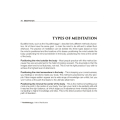
Buddhist texts, such as the Visuddhimagga¹, describe forty different methods of practice. All of them have the same goal: to train the mind to be still and to attain
Buddhist texts, like the Visuddhimagga, outline 40 meditation methods with the same goal of mastering the mind to achieve Buddhahood. Meditation can be categorized into three types: positioning the mi
104
Understanding the Mind and Human Existence
Luang Por then draws the circle within the circle that follows, regarding languages…
“As you can see, the language of the mind is far greater than any other language. And, because of this, the Buddha
Luang Por discusses the concept of the mind as a profound element that transcends language limitations. He explains how the human body, consisting of the four elements—earth, water, fire, and wind—is
93
Understanding the Impermanence of the Body and the Pursuit of Transcendence
wise will use the indications of deterioration in their own body to wake themselves up to the fact that the body can offer the spirit no true refuge.
**The Physical Body is a Storehouse of Unwholesome
The text discusses the physical body as a storehouse for unwholesomeness, suffering, and illnesses due to our desires. It contrasts this with the nine supreme transcendental attainments, which include
39
Interpretations of Dhammakāya in Early Pāli Texts
Gombrich, while differently translating the term in this passage as a bahubbiha compound 'dhamma-bodied,' similarly interprets it as an indication that the Buddha's true import is due to 'his teaching
This text delves into various scholars' interpretations of the term 'dhammakāya' within the context of early Pāli suttas. Gombrich views it as 'dhamma-bodied,' emphasizing that the essence of the Budd